
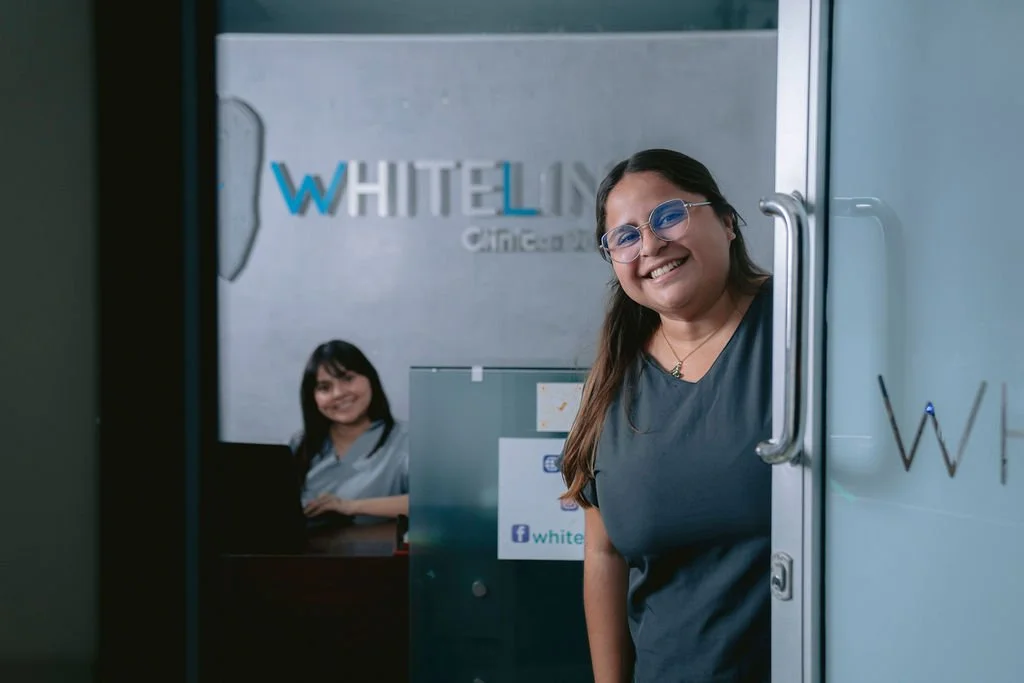
Here are some answers to Frequently Asked Questions from our beloved Whiteliners patients.
Want to know more?
About Our Treatments
-
Does teeth whitening damage teeth?
No, when it is performed by a professional and in the right way. At Whiteline, we use high-quality products and appropriate protocols that minimize sensitivity and allow us to perform the treatment correctly.
-
Do dental implants last a lifetime?
They can last for decades with proper care. Their success depends on factors such as hygiene, lifestyle, and regular checkups.
-
Which is better, a dental implant or a dental bridge?
It depends on each case. Implants help preserve bone and do not damage adjacent teeth, while bridges are a quicker solution and, depending on the material, relatively more economical. Each treatment has advantages and disadvantages, so it is important to properly evaluate your case to see which options are right for you.
We advise you without obligation!
-
Can I get braces or invisible aligners at any age?
Yes! Orthodontics has no age limit. We offer aesthetic and discreet options for adults.
-
Does dental cleaning wear down teeth?
No. We use ultrasonic technology that removes plaque and tartar without damaging the enamel.
-
How long will my dental treatment take?
It will depend on your case. It is very important to carry out an initial assessment and a proper diagnosis so that we can develop a personalized treatment plan and thus be certain about the duration of the treatment.
-
What tests are usually required before orthodontic treatment?
A lateral X-ray, a panoramic X-ray, and, in some cases, an intraoral scan.
-
What do I need to know to find out if I am a candidate for implants?
A CT scan, usually bimaxillary, and a consultation with the relevant specialists .
-
How is teeth whitening performed at the dental clinic?
First, we protect your gums and lips. Then, we apply a special whitening gel that contains a safe but powerful whitening ingredient.
The procedure usually takes about an hour. You may experience some temporary sensitivity during or after treatment, but this usually goes away quickly and varies from patient to patient.
-
How do they perform a dental cleaning?
With an ultrasonic device that allows us to remove plaque and tartar comfortably and effectively. After this, we polish with a prophylactic paste and a brush to leave the surface of the teeth smooth and shiny.
About Oral Health
-
Why are my gums bleeding?
It may be a sign of gingivitis (inflammation). If left untreated, it can develop into periodontitis.
-
How can I prevent cavities?
With daily hygiene (brushing, flossing), a low-sugar diet, and biannual visits to the dentist.
-
Which toothpaste is best for me?
It depends on your needs and your situation. We need to check whether you have sensitive teeth (which can be caused by various factors), inflamed gums, or a greater susceptibility to cavities in order to make the right recommendation.
Come and get an assessment with us!
-
What should I do if I lose a crown, denture, or filling?
Contact us immediately! In the meantime, avoid chewing on that side and try to keep the area as clean as possible.
For International Whiteliners Patients
-
Can I schedule all my dental treatment from my home country?
Yes. However, it all depends on your case. We offer free video calls to help you plan your trip to Mérida, including itineraries and, in cases that do not require an initial exploratory trip, estimates for your dental treatment.
-
Is Mérida a safe city for dental tourists?
Yes, it is one of the safest cities in Mexico. We can also help you with recommendations for accommodation and transportation.
-
Do you offer guarantees for your treatments?
Yes. All our procedures include guarantees, subject to conditions and periodic checks.
About Dental Treatments for Children
-
At what age should a child visit the dentist for the first time?
We recommend the first visit at age 1 or when their first tooth appears.
-
Are treatments for children painful?
We use minimally invasive techniques and a playful environment to ensure that your experience is positive.
About what happens after treatment
-
Is pain after a dental procedure normal?
Pain is often normal. It all depends on the procedure you underwent. We will give you personalized instructions according to your case. Medication is often necessary, and for this reason, we will give you a prescription so that you can obtain it.
-
What should I eat or avoid after treatment?
It all depends on the treatment you received. After the treatment, we will give you instructions to follow regarding your diet and care.
-
What happens if I don't have my wisdom teeth removed?
It all depends on the position of your molars. In many cases, when molars are not properly positioned, they can cause crowding and increased food accumulation, which in turn can cause infections or damage to adjacent teeth. We evaluate you clinically and with X-rays before any procedure.